If you’re like many people, the days of sitting in a classroom and solving endless math problems feel like a distant memory.
For some, numbers and formulas evoke a sense of curiosity and enjoyment, while for others, the mere mention of arithmetic can cause anxiety or boredom.
Yet, despite decades of moving away from traditional math exercises, the internet has created a new space for people to engage with numbers — in the form of brain teasers, puzzles, and logic challenges.
What’s remarkable is how these puzzles, often deceptively simple in appearance, can capture our attention for hours, igniting debate and discussion across forums, social media platforms, and online communities.
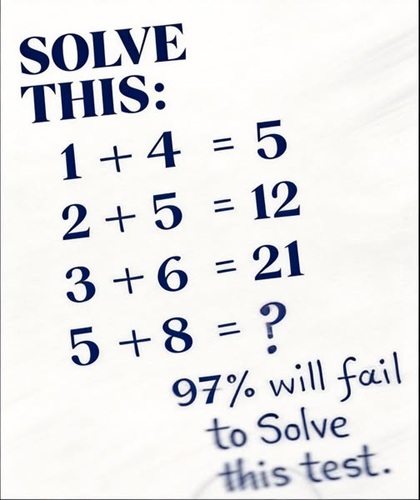
One of the most talked-about math puzzles in recent months has been the seemingly simple sequence:
1 + 4 = 5
2 + 5 = 12
3 + 6 = 21
5 + 8 = ?
At first glance, it looks like a basic arithmetic problem — straightforward addition that even a beginner might be able to solve. But the puzzle quickly becomes puzzling the moment you try to apply conventional rules of addition.
The results clearly don’t match standard arithmetic: 2 + 5 certainly does not equal 12, and 3 + 6 is not 21. This discrepancy is what makes the puzzle so intriguing.