Paula had worked in many houses like this one—large, elegant residences where silence was as carefully maintained as the polished floors. She was accustomed to discretion, to observing without being seen.
To performing her duties with precision and restraint. Yet from the moment she arrived at the estate, something about Felix unsettled her in a way she could not easily explain.
Felix was a quiet child, far quieter than children his age usually were. His stillness was not peaceful but tense, as if his body were constantly bracing for something unseen. His eyes, large and pale, followed movement rather than people.
And when spoken to, he responded more with expression than with words. Doctors came and went, specialists with impressive credentials and confident voices.
Yet none seemed able to explain the sudden headaches, the episodes of unexplained distress, or the way Felix flinched when touched unexpectedly.
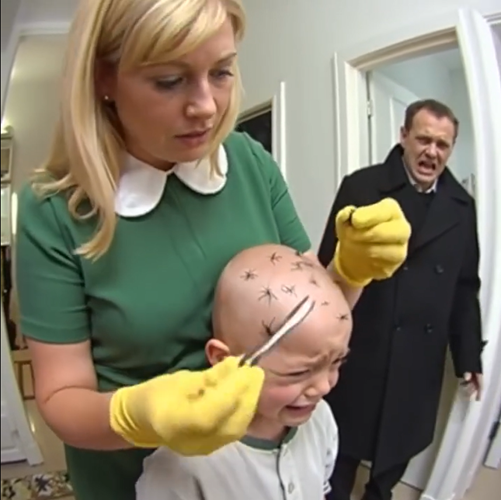
Paula noticed patterns others overlooked. She noticed how Felix’s stepmother, Camille, delegated nearly every aspect of the household to staff—meals, clothing, schooling arrangements, even medical appointments.
And yet, there was one task Camille never surrendered: washing Felix’s hair. She insisted on doing it herself, always alone, always behind closed doors.
At first, Paula dismissed her unease. Stepparents could be overprotective; appearances could deceive. But unease has a way of growing roots.
Over time, Paula saw how Felix stiffened whenever Camille entered the room, how his hand instinctively moved toward his head when her voice echoed down the corridor.
There was fear there—subtle, carefully hidden, but unmistakable to someone who had learned to read silence.
The moment that changed everything came late one evening. Felix had been seated quietly in the study, supposedly absorbed in a book. When Paula passed by, she felt his gaze lock onto her.
Slowly, deliberately, he raised his hand and pointed to the crown of his head. His eyes pleaded in a way words never could.
Something ancient stirred within Paula then—an instinct older than training, older than logic. It was the same instinct her grandmother used to speak of, the kind that told you when something was wrong even before your mind could name it.
She waited.
She waited until the house settled into its artificial sleep. The doctors had left. Camille’s door was closed. Even the security cameras, blinking red lights in dark corners, seemed to hum with indifference rather than vigilance.
Paula approached Felix quietly, her movements careful, respectful. She knelt in front of him and spoke in a whisper, her voice steady and calm.
She told him he was safe, that he was not imagining his pain, that she believed him. Felix did not speak, but his shoulders relaxed just enough to tell her she had been understood.
Her hands hovered near his head. She hesitated—not out of fear, but out of awareness. Crossing this boundary could cost her everything: her job, her reputation, even her freedom. But turning away would cost something far greater.
With measured care, she parted his soft, golden hair. Her fingers brushed against something that did not belong. It was subtle, hidden beneath skin and strands, but unmistakably foreign.
Her pulse quickened as she explored gently, guided by experience passed down through generations of women in her family—healers, midwives, caretakers who knew how to listen to the body.
There was an object beneath the skin. Small. Hard. Unnatural.
Felix winced, but he did not pull away. He trusted her.
Paula worked slowly, methodically, ensuring that her movements caused as little discomfort as possible. This was not medicine as taught in textbooks; this was care rooted in patience, observation, and respect. When the object finally came free, she caught her breath.
It was a tiny device—no larger than a grain of rice, metallic and intricately designed. It bore no markings, no identifiers, nothing that could easily explain its purpose. It did not belong in a child’s body. That alone was enough to confirm her worst fears.
Paula did not speculate beyond what she could reasonably understand. She did not assume how the device functioned or who had created it.
What mattered was simple and undeniable: someone had deliberately placed a foreign object into Felix’s scalp without consent, without transparency, and without medical justification.
She wrapped the device carefully and ensured Felix was clean and comfortable. She stayed with him until his breathing steadied and sleep finally came.
By morning, Paula had made her decision.
She approached Jonas in the light of day. He was a man accustomed to authority, to making decisions that affected companies and lives alike. Yet when Paula spoke, her calm certainty pierced through his composure.
She told him what she had noticed. What she had found. What she had removed.
She placed the small object on the table between them.
Jonas stared at it in silence. Slowly, understanding crept into his expression, followed by disbelief, then devastation.
He replayed every moment he had dismissed, every concern he had trusted others to manage. He realized, too late, that his confidence had blinded him.
The truth was unavoidable. Felix had not been ill. He had been harmed.
Camille’s carefully constructed image unraveled in an instant. The affection, the control, the isolation—what Jonas had once interpreted as dedication now revealed itself as something far darker.
Whether driven by ambition, fear, or malice, her actions had crossed a line that could never be justified.
Jonas understood then that power offered no protection from betrayal. That trust, once misplaced, could become a weapon.
And that responsibility could not be delegated when it came to a child’s safety. The authorities would handle the rest. Paula did not remain to witness the consequences.
Her role had never been about recognition or reward. It had been about listening when others did not, about acting when silence became dangerous.
As she left the estate, the sun rising behind her, Paula felt no triumph—only resolve. Felix would have a chance now. A chance to heal, to grow without fear, to live unburdened by secrets hidden beneath his skin.
And sometimes, Paula reflected, that was enough.