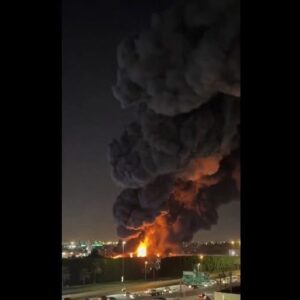
In Tehran, Iran’s foreign minister Abbas Araghchi addressed the nation following recent military strikes, delivering a response marked by firmness rather than spectacle. He described the attacks as a violation of Iran’s sovereignty and reiterated the country’s position that it retains the right to self-defense under international law. His remarks reflected a broader national mood—one shaped by defiance, fatigue, and the long pressure of sanctions and regional instability.
Across Tehran, public reaction has been mixed. Some citizens have called for a forceful response, while others have expressed concern about the costs of escalation. The tension between asserting national dignity and avoiding a wider conflict is evident not only in official statements, but in everyday conversations. For Iranian leadership, this moment represents a delicate balance between signaling resolve and preventing an irreversible slide toward regional war.
In contrast, officials in United States and Israel framed the operation as a defensive measure. U.S. representatives emphasized the goal of reducing perceived nuclear and security threats, while Israeli leaders characterized the action as necessary to protect national and regional stability. Both governments portrayed the strikes as limited in scope, though internal debates reportedly continue over the long-term consequences of such actions.
European governments responded with caution rather than alignment. Leaders in the United Kingdom, France, and Germany urged restraint, warning that cycles of retaliation could expand rapidly beyond their original intent. Their concern is informed by prior conflicts in which narrowly defined military actions escalated into prolonged crises, producing spillover effects such as energy disruption, cyber activity, and large-scale displacement.
At the United Nations, diplomats described a subdued atmosphere as emergency discussions were prepared. Many expressed unease about the erosion of shared norms governing the use of force and the growing difficulty of forging consensus among major powers. While calls for de-escalation were widespread, expectations for a unified response remained limited.
Financial markets have already reacted, with energy prices rising and investor sentiment turning cautious. Beyond economics, the broader impact is psychological: governments, institutions, and populations alike are adjusting to a period of heightened uncertainty. The coming days will test whether diplomatic channels can absorb the shock—or whether miscalculation will allow tensions to harden into a longer confrontation whose costs would extend far beyond the region.